CheckFile vs Jumio: complete comparison 2026
CheckFile vs Jumio comparison for the US — FinCEN, BSA, OFAC, CTA compliance. Which document verification solution to choose in 2026?

Summarize this article with
 ChatGPT
 Claude
 Perplexity
 Gemini
 Grok
GrokUS businesses operating under the Bank Secrecy Act (BSA), FinCEN reporting obligations, and OFAC sanctions requirements face a compliance landscape fundamentally different from the FCA-regulated environment where Jumio built its platform. Choosing between CheckFile and Jumio requires understanding which solution was architected with US regulatory reality in mind — and which one was later adapted to it.
This article is for informational purposes only and does not constitute legal, financial, or regulatory advice. Regulatory references are accurate as of the publication date. Consult a qualified professional for guidance specific to your situation.
Comparison table: CheckFile vs Jumio
| Criterion | CheckFile | Jumio |
|---|---|---|
| Document types | 3,200+ (identity + commercial + HR + legal + financial) | 5,000+ (primarily identity, 200+ countries) |
| Verification speed | 4.2 seconds average | 15–60 seconds (with liveness) |
| OCR accuracy | 98.7% | Not published (biometrics-first) |
| Fraud recall | 94.8% | Not published |
| False positive rate | 3.2% | Variable by configuration |
| Pricing | ~$0.13/document (public, pay-per-use) | $2–5/verification (enterprise contract) |
| Biometrics | No (document verification only) | Yes — selfie + iBeta Level 1 & 2 liveness |
| Data hosting | France (EU sovereignty) | Multi-cloud AWS/Azure (EU optional) |
| Compliance certifications | ISO 27001, SOC 2 | SOC 2 Type II, ISO 27001, PCI DSS |
| API integration | 2–5 days | 4–12 weeks |
| SLA | 99.94% | 99.9% (published) |
Jumio: biometric-first digital identity platform
Jumio is an integrated digital identity platform built around a single core proposition: confirming that a person is who they claim to be. Founded in 2010, Jumio's KYX platform combines government-issued document analysis with biometric facial verification and liveness detection to produce a unified identity decision. Its iBeta Level 1 and Level 2 certifications for presentation attack detection place it among the most rigorously validated liveness providers in the market.
Coverage spans 5,000+ identity document types across 200+ countries. For US businesses onboarding international customers at scale — particularly through consumer-facing mobile applications — Jumio's native iOS and Android SDKs deliver a guided capture experience that optimizes both usability and verification quality. Enterprise security certifications (SOC 2 Type II, ISO 27001, PCI DSS) underpin its posture with regulated clients.
The trade-offs are significant for US mid-market operators. Pricing is enterprise contract-based, with publicly cited benchmarks of $2–5 per verification depending on activated modules. Integration timelines run 4–12 weeks. And Jumio's primary scope is identity verification, not case file analysis: W-2s, paystubs, Certificates of Good Standing, or the multi-document dossiers that BSA/AML compliance routinely requires sit outside its native capabilities. Jumio's global architecture was designed around the FCA and international KYC context; US-specific regulatory workflows require additional configuration and, in some cases, supplemental tooling.
CheckFile: broad-spectrum document verification engine
CheckFile answers a different question from Jumio: not "who is this person?" but "is this case file complete, authentic, and compliant?" Rather than anchoring to a biometric identity flow, CheckFile verifies the integrity and consistency of entire document sets across 3,200+ document types — identity documents alongside commercial records, financial statements, HR documents, and legal filings.
For US-issued documents, coverage is comprehensive: US passports, all 50-state driver's licenses and state IDs, Green Cards (Form I-551), Employment Authorization Documents (EAD / Form I-766), SSN-related documents, and Form I-9 employment eligibility packets. On the commercial side, Certificates of Good Standing, Articles of Incorporation, state business registrations, W-2s, and 1099s are natively supported.
Hosted in France under EU data sovereignty principles, CheckFile integrates in 2–5 days via a documented REST API with no proprietary SDK requirement. At approximately $0.13 per document on a public pay-per-use grid, pricing is transparent from day one. ISO 27001 and SOC 2 certifications support the audit trail and traceability documentation that FinCEN expects under the BSA. CheckFile does not offer biometric facial verification — that function can be layered from a dedicated biometric provider, including Jumio, in a complementary architecture.
For a complete introduction to how document verification fits into KYC workflows, see our document verification guide.
Document and geographic coverage
The structural difference between the two platforms matters for CIP compliance: Jumio verifies identities; CheckFile verifies case files.
CheckFile's 3,200+ document types span identity (US passports, all state driver's licenses and state IDs, Green Cards, EADs), commercial records (Certificates of Good Standing, Articles of Incorporation, state business registrations), financial documents (bank statements, tax transcripts, W-2s, 1099s), and HR/legal filings. Form I-9 employment eligibility verification is supported — critical for employers subject to USCIS requirements. The platform covers 32 jurisdictions with deep document breadth within each.
Jumio's 5,000+ identity document types run across 200+ countries. For US-issued identity documents specifically — the US passport, all 50 state driver's licenses, the Green Card, the EAD — Jumio's recognition and biometric extraction are strong. NFC biometric data extraction from chipped passports is supported. Commercial, financial, and HR documents are outside Jumio's native scope.
For Customer Identification Program compliance under 31 CFR § 1020.220, you need both functions — identity confirmation and documentary case file analysis — and CheckFile and Jumio are architecturally compatible for that combination. See our identity verification solutions comparison for a broader view of how these platforms fit into a complete compliance stack.
Pricing: ~$0.13 per document versus opaque enterprise contracts
The cost differential between CheckFile and Jumio is among the largest in the document verification market. CheckFile's pricing is public: approximately $0.13 per document, with volume discounts applied at scale, no setup fees, and no minimum commitment. A business processing 5,000 case files per month, each requiring three documents — identity document, proof of address, and a supporting commercial record — pays roughly $1,950/month.
Jumio operates on enterprise contracts. Published benchmarks consistently cite $2–5 per verification depending on activated modules (document verification, biometrics, AML screening) and contracted volume. For the same 5,000 monthly case files, each requiring one complete Jumio identity verification, the cost reaches $10,000–$20,000/month — and that excludes commercial document processing, which requires additional tooling.
The volume math compounds quickly in US regulatory workflows. FinCEN Form 8300 cash transaction reporting, SAR filing documentation, and CTR recordkeeping all generate document verification volume beyond initial onboarding. For organizations processing BSA-required documentation at scale, the unit cost differential between $0.13 and $2–5 represents a material budget decision. See CheckFile pricing for the full public rate grid.
US regulatory compliance: FinCEN, BSA, and OFAC
This is the section that most directly separates US compliance realities from the global KYC context in which Jumio built its platform.
Bank Secrecy Act (BSA / 31 USC §5311): The BSA requires financial institutions, money services businesses (MSBs), and many regulated entities to maintain AML programs, file Currency Transaction Reports (CTRs) for cash transactions exceeding $10,000, and submit Suspicious Activity Reports (SARs) for transactions above $5,000 where laundering is suspected. The Anti-Money Laundering Act of 2020 (AMLA 2020) materially updated BSA requirements — including enhanced FinCEN priorities, new whistleblower protections, and expanded AML program requirements. Document verification supports the recordkeeping that AML program examinations audit.
FinCEN CIP Rule (31 CFR § 1020.220): The Customer Identification Program rule requires covered financial institutions to collect and verify specific identifying information — name, date of birth, address, and an identifying number (SSN or equivalent) — for each new individual customer. Document verification is the primary method for satisfying CIP requirements for both US citizens and non-citizens alike. CheckFile's extraction accuracy and structured data output directly support CIP recordkeeping obligations; Jumio's biometric layer supports the identity confirmation component.
OFAC sanctions screening: The Office of Foreign Assets Control administers US sanctions programs and maintains the Specially Designated Nationals (SDN) list. Covered businesses must screen customers and transactions against SDN and other blocked-party lists. CheckFile extracts and structures identity data — name, date of birth, document number, nationality — that feeds directly into OFAC screening workflows. CheckFile does not perform sanctions screening natively; the structured output integrates with dedicated OFAC screening tools or existing compliance systems. This separation of concerns is intentional: document verification and sanctions screening are distinct compliance functions.
Corporate Transparency Act (CTA) 2021: The CTA, effective January 2024, requires most US companies to report beneficial ownership information to FinCEN. Verifying the identity of beneficial owners — through US passports, state driver's licenses, state IDs, or Green Cards — is a core CTA obligation. CheckFile's multi-document capabilities directly support beneficial ownership information (BOI) verification across a complete ownership structure, covering both identity documents and the commercial filings (Articles of Incorporation, Certificates of Good Standing) that establish the reporting company itself.
Privacy: no federal law, a growing state patchwork: Unlike the EU (GDPR) or Canada (PIPEDA), the US has no comprehensive federal privacy law. Instead, a patchwork of state laws governs personal data processing: California CCPA/CPRA, Virginia VCDPA, Colorado CPA, Connecticut CTDPA, and others. CheckFile's EU hosting and configurable data deletion policies align with these frameworks, but US organizations must conduct their own state-by-state compliance analysis. Jumio's biometric data processing implicates additional state biometric privacy laws — Illinois BIPA and Texas CUBI — that impose notice, consent, and retention obligations beyond general privacy law. These requirements create additional DPIA burden for Jumio clients operating in those states.
State money transmitter licenses: MSBs operating across state lines must hold money transmitter licenses under a patchwork of 50+ state licensing regimes. Document verification supports the customer due diligence that licensing examinations routinely audit.
Technical integration: 2 days vs 4-12 weeks
No proprietary SDK is required. Webhooks support asynchronous processing for high-volume back-office workflows. A free 48-hour pilot lets you test against your actual document types before any commitment.
Jumio's integration model centers on its mobile SDK — encapsulating document capture, selfie collection, liveness detection, and the verification flow into an embeddable component. For consumer-facing mobile onboarding, this is a genuine advantage: guided capture and UX optimization come pre-built. The trade-off is integration complexity. Jumio's own documentation and market feedback consistently cite 4–12 weeks as the integration timeline — excluding the time required for compliance review of biometric data flows under Illinois BIPA, Texas CUBI, or other applicable state privacy laws.
For back-office compliance workflows — processing documents received by email, through a secure portal, or from internal systems — CheckFile's API-first architecture is the more direct fit. For consumer mobile onboarding where a biometric selfie is mandated, Jumio's SDK provides a materially better end-user experience. These use cases are not mutually exclusive.
Document fraud detection
These metrics are published and auditable across CheckFile's full 3,200+ document catalog.
Jumio approaches fraud from an identity angle: detecting falsified identity documents, biometric spoofing (printed photos, masks, deepfakes), and identity impersonation. Its iBeta Level 1 and Level 2 certifications for presentation attack detection confirm its rigor on the biometric fraud vector — specifically the fraud pattern where someone presents another person's authentic document alongside their own face, a vector that document-only analysis cannot catch.
The two approaches are complementary for synthetic identity fraud, which is a growing BSA/AML enforcement priority. Synthetic identities — fabricated from real SSNs combined with false biographical data — require both documentary analysis (detecting inconsistencies in the supporting documents) and biometric verification (confirming the applicant against a genuine identity). Layering CheckFile and Jumio covers both detection surfaces in a single workflow.
When to choose CheckFile
CheckFile is the right choice for US organizations when:
- BSA/AML, CIP (31 CFR § 1020.220), or CTA compliance requires multi-document case file verification — not just a single identity document at onboarding
- You process US-specific document types at volume: all 50-state driver's licenses and state IDs, US passports, Green Cards (Form I-551), EADs (Form I-766), SSN-related documents, Form I-9 packets, W-2s, 1099s, or Certificates of Good Standing
- Budget predictability and transparent pricing are operational requirements — at $0.13/document, costs scale linearly with volume without contract negotiation
- Your integration timeline is measured in days, not quarters — a REST API with no mandatory SDK integrates in 2–5 days
- You need structured identity data output for OFAC SDN screening — CheckFile's extraction provides clean, structured fields that feed directly into sanctions screening workflows
- You are subject to state-level privacy laws and want to minimize biometric data processing obligations under Illinois BIPA or Texas CUBI
Start a free pilot to test CheckFile with your actual document types before any commitment.
When to choose Jumio
Jumio is the right choice when:
- Your regulatory or product requirements mandate biometric identity verification — selfie-to-document facial comparison and iBeta-certified liveness detection that CheckFile does not provide
- You operate a consumer-facing mobile application where Jumio's native iOS/Android SDK delivers the guided capture UX that reduces document submission errors
- You onboard customers internationally across 200+ countries and need deep recognition of local identity document formats beyond US-issued documents
- Your KYC budget accommodates enterprise contract pricing at $2–5 per verification and your verification volume justifies the cost of Jumio's integrated biometric and AML platform
- Your compliance requirements are identity-centric and do not extend to commercial, financial, or HR document verification
Verdict
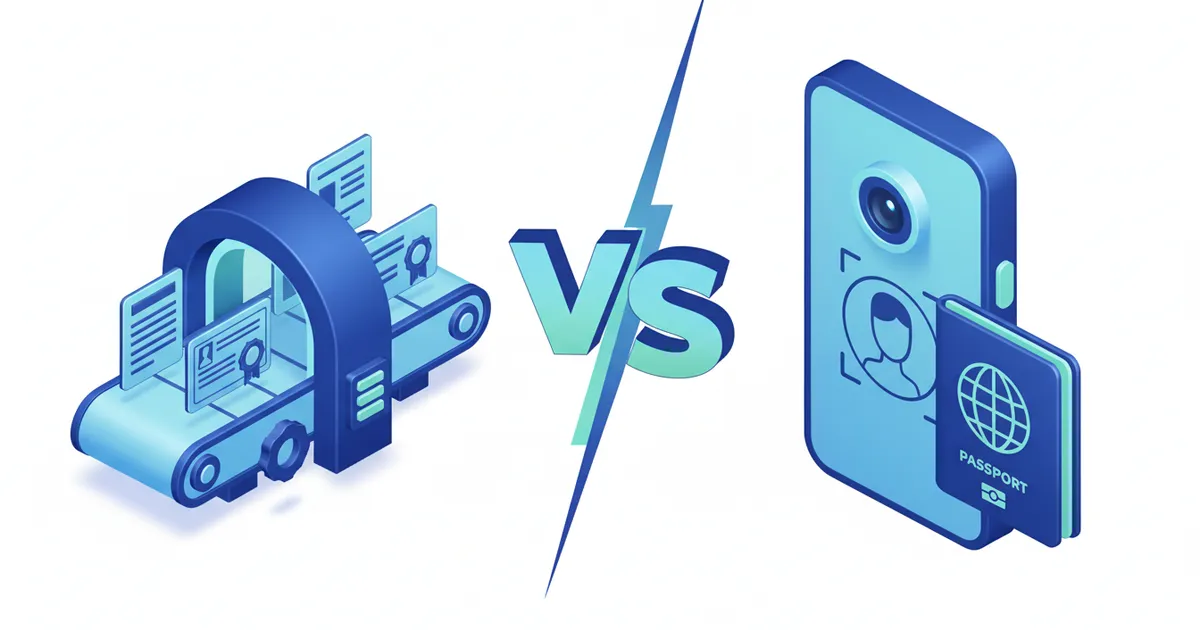
Jumio and CheckFile are not direct competitors across their full scope. Jumio is a complete digital identity platform built around biometric verification; CheckFile is a broad-spectrum document verification engine built for case file compliance.
For US businesses navigating BSA/FinCEN obligations, CIP requirements under 31 CFR § 1020.220, OFAC sanctions screening workflows, and the beneficial ownership reporting demands of the Corporate Transparency Act, the compliance challenge extends well beyond a single identity check at onboarding. CheckFile's multi-document coverage, transparent $0.13/document pricing, and 2–5 day API integration make it the more practical fit for the documentary compliance workload that US regulations actually impose.
For organizations that need both — biometric identity confirmation for consumer onboarding and multi-document case file analysis for ongoing BSA/AML compliance — CheckFile and Jumio are architecturally compatible. A common pattern uses Jumio for initial biometric KYC and CheckFile for the complete compliance dossier: CIP-required supporting documents, beneficial ownership records, Certificates of Good Standing, Form I-9 packets, and cross-validation across the full case file.
See also: Document Verification Guide · Identity Verification Solutions Comparison
Frequently Asked Questions
Does CheckFile satisfy FinCEN and BSA document verification requirements?
The platform is ISO 27001 and SOC 2 certified, and its configurable rules engine can enforce CIP (31 CFR § 1020.220) and CDD (31 CFR § 1010.230) validation logic across case files. CheckFile does not file CTRs or SARs on your behalf — those reporting obligations remain with the covered financial institution or MSB.
How does CheckFile handle OFAC sanctions screening?
CheckFile extracts and structures identity data from verified documents — name, date of birth, document number, nationality, and address — that feeds directly into OFAC SDN list screening workflows. CheckFile does not perform sanctions screening natively. The structured output integrates with dedicated OFAC screening tools or your existing compliance systems via the REST API. This separation is intentional: document verification and sanctions screening are distinct compliance functions with different update cadences and regulatory responsibilities.
Can CheckFile and Jumio be used together?
Yes, and it is a well-established architecture for US organizations with varied verification needs. A typical implementation uses Jumio for biometric KYC at consumer onboarding — document capture, selfie comparison, iBeta-certified liveness detection — then CheckFile for the complete BSA/AML compliance dossier: W-2s, paystubs, bank statements, Certificates of Good Standing, beneficial ownership documents, and Form I-9 packets. Both REST APIs integrate independently into the same workflow, each covering its own scope.
What US document types does CheckFile support?
CheckFile supports US passports, all 50-state driver's licenses and state IDs, Green Cards (Form I-551), Employment Authorization Documents (EAD / Form I-766), and SSN-related documents for individual identity. On the commercial and compliance side: Certificates of Good Standing, Articles of Incorporation, state business registrations, Form I-9 employment eligibility packets, W-2s, 1099s, bank statements, and tax transcripts are natively supported. The full catalog of 3,200+ document types is available via the CheckFile API documentation. Coverage includes the document types most commonly required for CIP (31 CFR § 1020.220) and CTA beneficial ownership verification.
Does Jumio's biometric processing trigger state privacy law obligations?
Yes. Jumio's biometric data processing — facial comparison and liveness detection — constitutes biometric data collection under state biometric privacy laws including the Illinois Biometric Information Privacy Act (BIPA) and the Texas Capture or Use of Biometric Identifier Act (CUBI). These laws impose notice, written consent, and data retention and destruction requirements that go beyond general state privacy law obligations under the California CCPA/CPRA or similar frameworks. US organizations deploying Jumio in Illinois or Texas — or processing biometric data of residents of those states — should conduct a Data Protection Impact Assessment (DPIA) covering the biometric processing flows before go-live. CheckFile's document-only verification does not trigger BIPA or CUBI.
ISO 27001, SOC 2 certified. Public pay-per-use pricing from ~$0.13/document. Review our security overview for full technical and compliance documentation.*
Stay informed
Get our compliance insights and practical guides delivered to your inbox.